
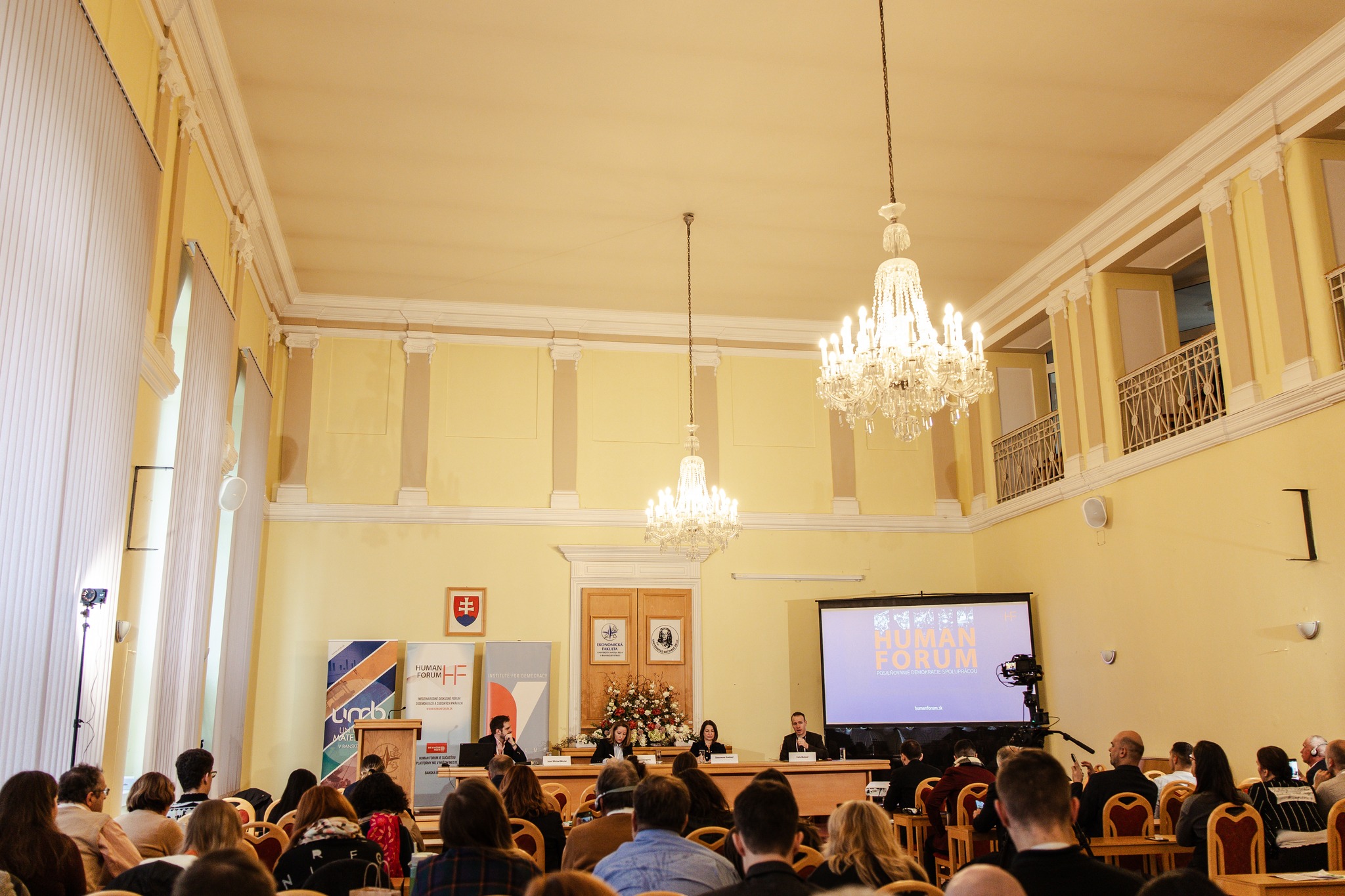
The 12th annual Human Forum once again transformed Banská Bystrica into a crossroads of democratic thought and action. Over three days, more than a hundred speakers and participants: academics, diplomats, civil society leaders, public officials, journalists, artists, religious representatives, and citizens, gathered across three venues in the city to debate, reflect, and collaborate under this year’s umbrella theme: “Strengthening Democracy through Cooperation.”
What began in 2014 as a local response to the rise of extremism in central Slovakia has grown into one of Central Europe’s most distinctive democracy and human rights festivals, a space where keynote lectures and street-level civic engagement coexist, where research papers share the programme with ecumenical services, and where ambassadors sit in the same audience as community activists from small Slovak towns.
Human Forum 2025 confirmed that evolution in full colour.
Research at the Heart of the Festival: The BRRIDGE Final Conference
This year’s edition carried a special significance for the Institute for Democracy’s research mission. The Final Conference of the BRRIDGE Horizon Europe project was fully integrated into the Human Forum programme, creating strong synergies between academic inquiry and the civil society–driven debates that define the festival. The integration proved to be a natural fit: BRRIDGE brought research-based, data-driven insights while remaining deeply grounded in the democratic values that Human Forum has championed since its founding: freedom, human rights, pluralism, and public participation.
BRRIDGE anchored the research dimension of the Forum through three major panel debates and two keynote lectures, each featuring leading international scholars.
Keynote Lectures
Zsuzsanna Szelényi (Central European University, Budapest) opened the second day with a lecture on “Democratic Resilience and the Future of Civic Space in Central Europe”, setting the frame for the day’s discussions on identity, fragmentation, and the future of democratic engagement.
Philipp Ther (University of Vienna) delivered a lecture entitled “From Neoliberalism to Anti-Liberalism: The Great Transformation after ’89”, offering a sweeping historical account of how the post-communist transition produced not only democratic consolidation but also the conditions for its unravelling.
Panel Debates
“Political Promises and Economic Reality: How Authoritarian and Populist Tendencies Shape the Future of the Economy” Erik Jones (European University Institute), Martin Kahanec (Central European University), and Michal Mešťan (Matej Bel University) examined the economic dimensions of democratic backsliding, moderated by Kamila Borseková (UMB).
“The End of ‘Us’? Democratic Engagement After the Decline of Coherent Political Identities” Felix Butzlaff (Central European University, Vienna), Zsuzsanna Szelényi (CEU Budapest), and Katarína Klingová (GLOBSEC) explored how the fragmentation of political identities reshapes civic mobilisation, moderated by Jozef Michal Mintal (UMB).
“Gender Fatigue — When Equality Becomes a Battleground” Mary McGill (University of Galway), Veronika Valkovičová (Comenius University), and Mária Žuffová (European University Institute) unpacked how gender equality has become a polarising fault line in democratic politics, moderated by Ilker Kalin (UMB).
Associated BRRIDGE Side Events
Alongside its main programme, BRRIDGE supported two important side events designed to strengthen cooperation and capacities within the wider Human Forum ecosystem:
- “Together for a Resilient Democracy” — a POSILA-supported, closed-door working session bringing together 20 representatives from civil society and related sectors to exchange perspectives on cooperation and democratic resilience. Led by the Institute for Democracy at UMB, it provided a focused, practical space for dialogue complementing the Forum’s more public debates.
- Workshop on Horizon Europe Projects — delivered by Joanna Wielgo (European University Institute), the session equipped local actors, university staff, and civil society representatives with tools for navigating and succeeding in Horizon Europe calls, supporting long-term participation in European research frameworks.
Diplomacy, Civic Life, and the Spaces in Between
Human Forum’s distinctive character lies in its ability to bring together worlds that rarely share a stage.
Ambassador Roundtable
The first day’s programme culminated in a roundtable with H.E. Nicolas Suran (Ambassador of France), H.E. Ian Devine (Ambassador of Ireland), H.E. Peter Nelson (Ambassador of Switzerland), and H.E. the Ambassador of the United Kingdom to Slovakia. Moderated by geopolitical analyst Pavol Demeš, the session explored the evolving forms of democracy and the role of international cooperation in defending democratic norms.
Civil Society and the Rule of Law
Multiple sessions addressed the state of civic space in Slovakia. Laura Dittel of the Democracy Platform presented on the conditions for civil society engagement, while a panel on “Bottom-up Cooperation” brought together activists from Nitra, Lučenec, and Zvolen to share experiences of community organising and volunteering, moderated by Csilla Droppová. A separate evening session asked directly: “How Should Civil Society and the Rule of Law Interact?” — with contributions from the Slovak National Human Rights Centre, the Helsinki Committee, the Democracy Platform, and UMB, moderated by Karolína Piliarová.
Co-governance
A dedicated panel on co-governance brought together city and regional officials with academic experts in smart cities and urban planning to discuss wise, inclusive territorial management, moderated by Katarína Vitálišová.
The Role of Business in Civic Life
A Wednesday afternoon panel examined the role of corporate foundations in sustaining civil society, featuring representatives from the Pontis Foundation, the Volkswagen Foundation, and crowdfunding platform Donio, moderated by Claudia Alner (GLOBSEC).
OSCE and the Public Defender of Rights
Tea Jaliashvili of the OSCE Office for Democratic Institutions and Human Rights (ODIHR) spoke on European future protection, and Robert Dobrovodský, Slovakia’s Public Defender of Rights, addressed the Forum on strengthening civil society and local democracy.
The European Commission
Radim Dvořák of the European Commission’s Representation in Slovakia spoke on the values, realities, and civic engagement that define Slovakia’s place in Europe.
Democracy Starts at School
The Forum’s third day was dedicated to education and democratic resilience among young people. Opened by Ondrej Lunter, Chairman of the Banská Bystrica Self-Governing Region, the day featured three practical programmes demonstrating how democratic values can be cultivated in schools:
- “Schools for Democracy” — presenting measurable shifts in student values and democratic attitudes
- “ImpactGames” — experiential learning through games on human rights and civic engagement
- “Emotional Compass” — linking mental health support to active citizenship and radicalisation prevention
A Festival of Democratic Life
Human Forum 2025 was not only an intellectual programme. It was, as it has been every year, a festival — a gathering that insists democracy is also something lived, felt, and shared.
The Human Forum Prize
The gala evening on the first day saw the awarding of the Human Forum Prize. This year’s laureate was Jozef Klement, the Zvolen-based entrepreneur and civic leader, honoured posthumously. Klement was the founder of “Forgotten Neighbours” (Zabudnutí susedia), a project that grew to encompass over a hundred towns and villages across Slovakia, where volunteers gather annually to read aloud the names of Holocaust victims and their rescuers, ensuring that the stories of the past are not forgotten. His family, his wife, two daughters, and grandson, accepted the award on his behalf in what became one of the most moving moments of the Forum. Klement’s life embodied the values Human Forum stands for: a commitment to community, historical memory, and the conviction that democracy is built through everyday acts of civic responsibility.
“Dialogues on Humanity”
An exhibition opened alongside the gala evening, offering a visual counterpart to the Forum’s debates.
Ecumenical Service
On Tuesday evening, representatives of Catholic, Protestant, Greek Catholic, and other Christian traditions, together with representatives of the Jewish and Muslim communities, gathered at the Parish Church of the Ascension of the Virgin Mary for an ecumenical service, a quiet but powerful expression of the pluralism that lies at the core of the Forum’s identity.
Superar Choir
The Superar children’s choir provided musical accompaniment to the gala evening, adding a layer of beauty and intergenerational symbolism to the proceedings.
“NS-Film: Dramaturgy of Manipulation”
The Forum closed with an audiovisual lecture at the SNP Museum Cinema on Nazi propaganda mechanisms (1933–1945), presented by Zuzana Heldt and Fedor Mosnák — a sobering reminder that the defence of democracy requires understanding how it has been attacked before.
Looking Ahead
Human Forum 2025, enriched by the BRRIDGE Final Conference, demonstrated how research, civil society, public institutions, and citizens can jointly contribute to democratic renewal. It was a space where data met values, and where cooperation became both a principle and a method for protecting democratic life.
Science and research were not an add-on to this ecosystem, they were a full part of it, demonstrating how academic expertise can strengthen democratic resilience when it is willing to step beyond the walls of the university.